
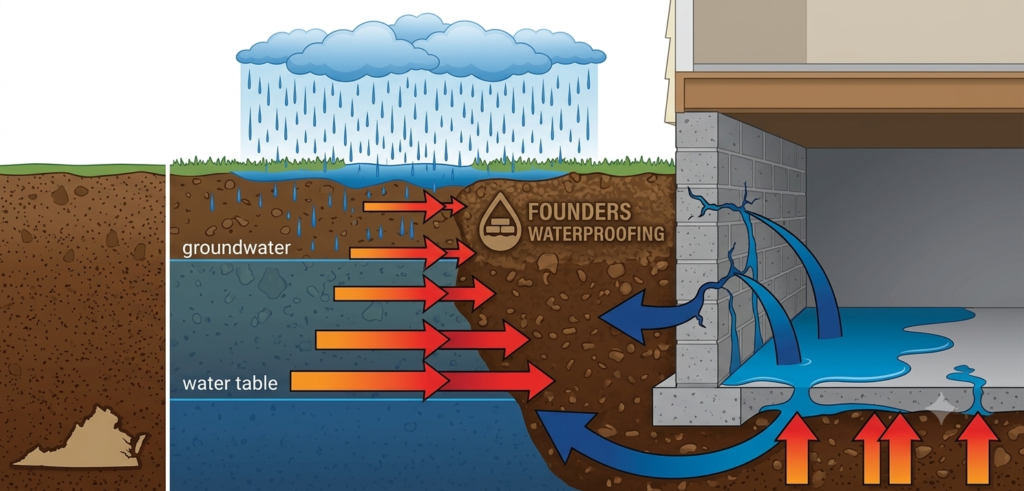
Understanding Hydrostatic Pressure Around Your Basement
Basement water problems often begin beneath the ground, where homeowners cannot see the forces building up around their foundation. One of the most common causes of basement moisture and water intrusion is hydrostatic pressure, which develops when water accumulates in the soil surrounding a home. In Virginia, changing weather conditions, heavy rainfall, clay-rich soils, and seasonal groundwater fluctuations can increase the amount of moisture pressing against basement walls and floors. When this pressure becomes greater than the resistance of the foundation, water can find its way through small cracks, construction joints, and other vulnerable areas. We understand how frustrating it can be to discover damp walls, standing water, or persistent musty odors in a basement that should remain dry. Understanding how hydrostatic pressure works is the first step toward identifying the source of water intrusion and choosing an effective waterproofing solution.
What Is Hydrostatic Pressure?
Hydrostatic pressure is the force exerted by water when it accumulates within the soil surrounding a structure or beneath its foundation. When rainwater or groundwater cannot drain away efficiently, it creates a buildup of moisture around basement walls and underneath the concrete floor. As the amount of water increases, the pressure exerted against these surfaces can also increase, particularly when water collects at greater depths. Concrete is strong and durable, but it is not completely waterproof, and even well-built foundations can develop weaknesses over time. Small openings, porous concrete, deteriorating mortar, and gaps between foundation components can provide pathways for water to enter. We evaluate these conditions carefully because controlling the pressure and managing the surrounding water are often essential to achieving lasting basement moisture protection.
Why Hydrostatic Pressure Is a Concern for Virginia Homes
Virginia experiences a variety of weather conditions that can contribute to basement water intrusion throughout the year. Heavy spring showers, summer thunderstorms, tropical weather systems, and periods of prolonged rainfall can saturate the ground around residential foundations. When the soil becomes saturated, its ability to absorb additional water decreases, allowing moisture to collect near basement walls and beneath foundation slabs. Some properties also experience seasonal groundwater changes that increase the likelihood of water entering below-grade spaces. Homes situated on sloped lots, in low-lying areas, or near streams and other water features may face additional drainage challenges depending on local conditions. At Founders Waterproofing, we recognize that every property has different soil characteristics, drainage patterns, and foundation conditions, which is why identifying the underlying cause of water intrusion is important before recommending a repair.
How Water Builds Pressure Against Basement Walls
Water begins to create hydrostatic pressure when it accumulates in the soil surrounding the buried portions of a foundation. Under normal conditions, rainwater should move away from the house through properly graded landscaping, suitable drainage systems, and soil that allows adequate water movement. However, compacted soil, poorly positioned downspouts, blocked drains, and naturally slow-draining ground can prevent water from moving away efficiently. As moisture accumulates, the water exerts pressure against the exterior surface of the basement walls. This pressure can force water through existing cracks, porous concrete, weak mortar joints, and openings where utility lines enter the foundation. When the surrounding soil remains saturated for an extended period, the pressure may persist even after rainfall has stopped, making recurring basement leaks difficult to resolve without addressing the source.
How Water Enters Through Basement Foundation Cracks
Foundation cracks are among the most recognizable pathways for hydrostatic water intrusion. Concrete can develop cracks because of curing shrinkage, soil movement, settlement, temperature changes, or structural stress, and these openings may become entry points when water pressure increases around the foundation. Even a narrow crack can allow moisture to seep into the basement when the surrounding soil remains saturated. Homeowners may initially notice a faint damp line, a small water stain, or mineral deposits forming along the wall. During heavier rainfall, the same opening may begin to leak more noticeably, allowing water to collect on the basement floor. We assess the location, size, pattern, and behavior of foundation cracks to determine whether water intrusion is primarily related to moisture pressure, drainage problems, structural movement, or a combination of these conditions.
The Role of Concrete Porosity in Basement Water Intrusion
Many homeowners assume that concrete provides a completely waterproof barrier against groundwater, but concrete naturally contains tiny pores and capillary pathways. When soil surrounding a foundation becomes saturated, water can move through these pathways and gradually appear on the interior surface of basement walls or floors. This process can occur even when there are no obvious cracks in the concrete. Persistent moisture may cause discoloration, peeling paint, damaged wall finishes, or white mineral deposits commonly known as efflorescence. These deposits develop when water carries dissolved minerals through the concrete and leaves them behind as the moisture evaporates. Addressing concrete porosity may require an appropriate waterproofing treatment, but the most effective approach also considers the amount of water surrounding the foundation and whether drainage improvements are necessary.
Why Basement Floor Joints Can Become Water Entry Points
The joint where a basement wall meets the concrete floor is another common location for hydrostatic water intrusion. This connection, often called the cove joint, can provide a pathway for water when pressure builds beneath or around the foundation. In many homes, the basement floor slab and foundation walls are constructed separately, creating a joint that may be more vulnerable to water movement than a continuous concrete surface. When groundwater levels rise or the soil beneath the slab becomes saturated, water can move through this joint and appear along the edges of the basement floor. Homeowners may notice damp corners, small puddles near the perimeter, or water emerging after several hours of heavy rainfall. We investigate these symptoms carefully because recurring water at the cove joint may require an interior drainage system, a sump pump, exterior water management improvements, or a combination of solutions based on the property’s specific conditions.
How Virginia Soil Conditions Affect Hydrostatic Pressure
Soil composition plays a significant role in how water moves around a home’s foundation. Clay-rich soils can retain substantial amounts of moisture and drain slowly under certain conditions, allowing water to remain near basement walls after rainfall. When these soils become saturated, they may contribute to sustained pressure against buried foundation surfaces, particularly where drainage is inadequate. Other soil types, including sandy or gravelly soils, may allow water to move more readily, although groundwater can still accumulate depending on site conditions and the surrounding geology. Expansive clay soils can also change volume as their moisture content fluctuates, potentially contributing to movement or stress in some foundations. Because soil conditions vary throughout Virginia, we consider the property’s location, grading, drainage patterns, and visible signs of foundation movement when evaluating basement water problems.
Warning Signs of Hydrostatic Pressure in Your Basement
Hydrostatic pressure does not always cause an immediate flood, and early warning signs can be easy to overlook. Damp patches on basement walls, recurring moisture along the floor perimeter, and water appearing after storms may indicate that groundwater is finding a path into the home. Other warning signs include peeling paint, bubbling wall coatings, musty odors, and white mineral deposits on concrete surfaces. Homeowners may also notice water entering through previously dry cracks or small puddles forming in the same areas whenever the ground becomes saturated. In more severe cases, significant groundwater pressure may contribute to water seepage beneath a basement slab or place stress on vulnerable foundation components. If you notice these symptoms, we recommend investigating the source promptly rather than simply covering the affected surfaces, because cosmetic repairs alone will not eliminate the underlying water pressure.
The Difference Between Hydrostatic Pressure and Plumbing Leaks
Not every basement leak is caused by groundwater, so identifying the source of moisture is an important part of the repair process. Hydrostatic water intrusion often becomes more noticeable during or after heavy rainfall, particularly when water appears through foundation cracks, wall-floor joints, or multiple areas around the basement perimeter. Plumbing leaks may occur regardless of weather conditions and can be associated with water supply lines, drainpipes, water heaters, or other household equipment. Condensation can also create damp surfaces when warm, humid air comes into contact with cooler basement materials. Although these problems can produce similar symptoms, their solutions are different, and treating the wrong source may leave the original issue unresolved. At Founders Waterproofing, we focus on understanding the circumstances surrounding the moisture, examining visible entry points, and identifying drainage or foundation conditions that may be contributing to the problem.
How Poor Exterior Drainage Increases Foundation Water Pressure
Exterior drainage is one of the most important factors in controlling the amount of water that reaches a basement foundation. When gutters overflow, downspouts discharge too close to the house, or the surrounding ground slopes toward the foundation, rainwater can collect directly beside basement walls. Repeated exposure to concentrated runoff increases the likelihood that the nearby soil will become saturated, particularly during extended periods of rainfall. Clogged gutters, damaged drainage pipes, and depressions in the landscaping can make the situation worse by allowing water to remain close to the structure. Improving these conditions can reduce the amount of water reaching the foundation and help relieve the conditions that contribute to hydrostatic pressure. We often consider exterior drainage improvements as part of a broader waterproofing strategy because managing surface water can help prevent recurring basement moisture problems.
Basement Waterproofing Solutions for Hydrostatic Pressure
Effective basement waterproofing begins with identifying how water reaches the foundation and where it enters the basement. Depending on the property’s conditions, a solution may involve improving exterior grading, redirecting downspouts, repairing suitable foundation cracks, installing drainage components, or managing groundwater beneath the basement floor. Exterior waterproofing may include appropriate foundation wall protection and drainage measures designed to limit water accumulation against buried surfaces. Interior drainage systems can collect water that reaches the foundation and direct it toward a suitable discharge point, while a sump pump can remove collected groundwater from the system. In some situations, sealing localized openings may also be appropriate, but surface sealants alone may not withstand persistent water pressure if the underlying drainage problem remains unresolved. At Founders Waterproofing, we consider the source, severity, and pattern of water intrusion before determining which combination of waterproofing measures is most appropriate for the property.
How Interior Drainage Systems Help Manage Groundwater
An interior drainage system is designed to collect water that enters or accumulates around the basement perimeter and direct it away from the living space. Depending on the design, this system may include a drainage channel installed along the foundation’s interior edge, beneath the basement slab, or in another suitable location. Water collected by the drainage components is directed toward a sump basin, where a sump pump can discharge it to an appropriate location in accordance with applicable requirements. This approach does not necessarily stop groundwater from reaching the foundation, but it can provide a controlled route for water to leave the basement instead of accumulating on the floor. Proper installation, discharge routing, pump capacity, and maintenance are important to the system’s performance, especially during periods of heavy rainfall. We assess whether interior drainage is suitable for the home by considering the observed entry points, basement layout, existing drainage infrastructure, and the volume of water that needs to be managed.
The Importance of Sump Pumps During Heavy Rainfall
A sump pump can play an important role in protecting a basement where groundwater regularly accumulates. The pump sits in a sump basin and activates when water reaches a designated level, moving the collected water through a discharge line away from the foundation. During periods of prolonged rainfall or elevated groundwater, a properly selected pump can help prevent water from accumulating in the basement. However, a sump pump is only one part of a complete water management strategy, and it cannot compensate for every drainage or structural problem. Homeowners should ensure that the discharge line directs water away from the home and does not simply return it to the soil beside the foundation. Regular inspection, testing, and maintenance are also important, while a battery backup or other appropriate backup arrangement may provide additional protection during power outages.
Can Hydrostatic Pressure Damage a Basement Foundation?
Hydrostatic pressure can cause more than cosmetic moisture problems, although the severity depends on the foundation’s condition, construction, and surrounding soil. Persistent water intrusion can damage flooring, wall finishes, stored belongings, and materials installed inside the basement. Long-term moisture may also contribute to conditions that support mold growth when suitable moisture, temperature, and organic materials are present. In some circumstances, substantial lateral soil and water pressure can contribute to bowing basement walls, widening cracks, or other signs of structural distress, particularly when the foundation is already vulnerable. Water pressure beneath a basement slab can also contribute to water seepage through floor cracks and joints, and severe groundwater conditions may require specialized evaluation. If you observe significant wall movement, rapidly widening cracks, substantial water entry, or signs of floor displacement, we recommend obtaining a qualified assessment to determine whether structural repairs or additional groundwater controls are necessary.
Preventing Hydrostatic Pressure Before Water Enters the Basement
Preventive maintenance can reduce the amount of water that accumulates near a home’s foundation. Keeping gutters clear, maintaining functional downspouts, and directing runoff away from the house can help limit the amount of rainwater reaching basement walls. The soil around the foundation should generally slope away from the building where practical, while landscaping and hard surfaces should not direct concentrated runoff toward basement windows or foundation openings. Homeowners should also inspect accessible foundation areas for new cracks, damaged sealants, and signs of recurring dampness after significant rainfall. Existing drainage systems and sump pumps should be checked periodically to confirm that they remain functional and that water is being discharged appropriately. We encourage homeowners to address small drainage concerns early because preventing repeated soil saturation can help reduce the likelihood of more persistent basement water intrusion.
When Should Virginia Homeowners Schedule a Basement Inspection?
The right time to schedule an inspection is when water intrusion becomes recurring, when visible warning signs appear, or when you suspect that drainage conditions are changing around the property. You do not need to wait for a major basement flood before investigating damp walls, musty odors, or water stains. An inspection can help determine whether the moisture is associated with hydrostatic pressure, surface runoff, plumbing problems, condensation, or another source. It can also identify conditions that may require additional attention, such as deteriorating mortar, foundation cracks, blocked drainage components, or signs of structural movement. Homeowners in Virginia should pay particular attention to recurring leaks after heavy rain, seasonal changes in groundwater, and areas where water consistently collects near the house. By identifying the source early, you can make a more informed decision about repairs and reduce the risk of repeated damage to the basement and its contents.
Protect Your Virginia Basement With the Right Waterproofing Strategy
Hydrostatic pressure is a common reason water enters basements, but the most effective solution depends on how water moves through the soil and interacts with the foundation. Improving exterior drainage, managing groundwater, addressing vulnerable foundation openings, and installing suitable drainage equipment can help control water intrusion when these measures are matched to the property’s needs. Simply painting over damp concrete or sealing a visible stain may provide temporary cosmetic improvement without addressing the conditions that caused the water to appear. A comprehensive assessment helps distinguish between minor moisture concerns and problems that require a more extensive waterproofing or structural solution. We work to help homeowners understand the factors contributing to basement water intrusion and the options available for improving moisture control. If your Virginia home experiences recurring basement leaks, damp foundation walls, or water along the floor joints, contact Founders Waterproofing to discuss an appropriate approach to protecting your basement from unwanted water.